Intention
What is the person trying to achieve, protect, avoid or preserve—and which habitual cognitive routes are shaping that intention?
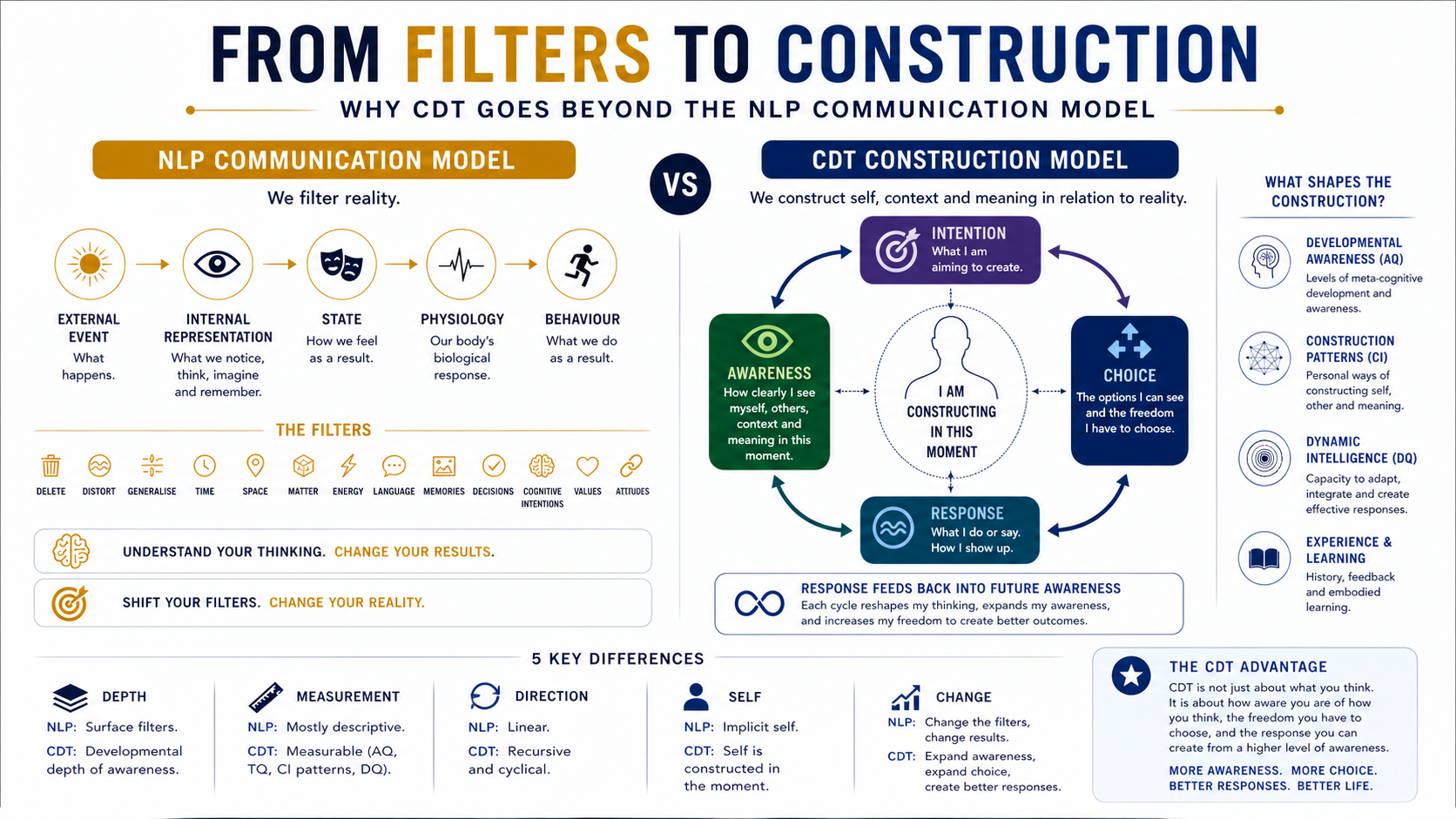
CDT explains how a person constructs self, other people, context, meaning, choice and response in real time—and how awareness changes what becomes available to construct. [1]
Every response has a construction behind it: what the person intended, noticed, ignored, interpreted, felt able to choose and ultimately enacted.
Much of this process happens habitually and outside immediate awareness. A familiar response can therefore feel like personality, truth or inevitability even though it is being constructed through repeated patterns of thinking.
CDT makes that process available for examination. Within CDT, development concerns becoming more able to notice the construction, hold greater complexity and choose a response deliberately rather than reproduce it automatically.
Two people can enter the same meeting. One constructs challenge and becomes curious; another constructs threat and becomes defensive. The event is shared. The available awareness, meaning, choice and response are not.
IACR is CDT’s core developmental architecture. It describes how intention moves into constructed response, with Awareness as the point at which construction can become visible and another choice may become usable. [1] [2]
What is the person trying to achieve, protect, avoid or preserve—and which habitual cognitive routes are shaping that intention?
How much of that construction can the person currently notice, including their own thinking, emotion and effect on others?
Which alternatives are genuinely available once the person becomes more aware of the construction and its context?
What becomes visible in behaviour after intention has moved through the awareness and choice available in that moment?
IACR is recursive, not a four-step decision checklist. Responses and consequences reshape the next encounter. Construction is the underlying activity between intention and response; awareness concerns its visibility. Noticing a habitual frame does not guarantee that an alternative can immediately be enacted.
What began as a set of related ideas has developed into an integrated architecture for observing construction and development.
Directions of cognition through which people construct attention, meaning, motivation and response. The framework developed from Meta-Programmes and reframes their use around intention, polarity and awareness. CIs describe contextual construction, not personality identities.
The context-sensitive combination of Cognitive Intentions a person uses regularly. It describes a preferred route of construction rather than a fixed personality type.
The live ability to recognise and navigate construction from intention through awareness and choice into an effective response.
The current developmental model and proposed measure of dynamic awareness: how aware a person is of constructing with their available cognitive structure, in a particular moment and context.
In current terminology, TQ concerns structural cognitive complexity: the capacity to hold perspectives, systems, principles, contradictions and transformations of frame. This must be distinguished from awareness of using that structure.
The developmental space between a current automatic construction and the next deliberate construction a person can genuinely use, given the available support and context.
A person, group, system or environment may make greater complexity available than someone is currently constructing alone. Development depends on whether that difference becomes visible and usable; exposure alone is insufficient. AQ+1 names a conceptual relationship, not a validated numerical dose.
Relationships, language, norms, resources and power shape what can be noticed, chosen and enacted. The environment can expose or suppress complexity; the person’s response can in turn reshape the conditions of the next encounter.
CDT does not discard stage development. It changes the emphasis from locating the person abstractly to examining what they can access and construct in a specific context.
This describes a broad developmental altitude or structural tendency, but may not show what is available in the live moment.
This examines awareness, complexity and response as context-sensitive availability rather than a fixed possession.
AQ and TQ describe different aspects of the architecture. The current models and proposed measures require explicit assessment procedures and independent validation; their descriptions alone are not scoring instruments. [1]
AQ describes shifts in the awareness from which a person can construct self, other people, context and response. Higher AQ reflects greater visibility of construction and greater availability of deliberate choice; it is not a substitute for TQ’s account of structural complexity.
In the current framework, TQ describes structural cognitive complexity, including the capacity to hold perspectives, systems, principles, contradictions and transformations of frame. It remains distinct from AQ: stage or complexity is not the same as awareness.
The original research examined the thinking and behaviour of postgraduate students through metacognition, constructivism and adult-stage development, initially using Identity Compass profiles. A later study tested the emerging model against a large organisational dataset of more than 8,000 profiles.
[2] As the studies progressed, the question developed from mapping patterns of thinking towards whether Dynamic Intelligence could provide a conceptual measure of self-awareness in the moment. The thesis used TQ as its principal benchmark; that thesis-era construct should not be treated as identical to the later distinction between AQ and TQ.
IACR remains central, while later authorial work differentiates AQ from TQ and elaborates contextual availability. Later formulations should be distinguished from the constructs examined in the original studies.
CDT was initially positioned in relation to personality, intelligence, emotional intelligence, metacognition and stage development. Its concepts appeared as related territories.
CIs describe routes of construction; AQ concerns available awareness; TQ concerns structural complexity; DI describes awareness in the moment. Real-Time Modelling brings this inquiry into the live encounter, with interpretations open to correction.
“The work has moved from naming the ingredients to explaining the construction process.”
These are proposed areas of application, not reports of demonstrated outcomes. Practice remains within the practitioner’s competence and professional scope, with consent and attention to the person’s circumstances.
Reveal the construction beneath goals, limitations and repeated patterns.
Examine how authority, disagreement and uncertainty are constructed, and which alternative responses become usable.
Move beyond content acquisition towards metacognition and adult development.
Examine how leaders and systems construct culture, problems and available action.
Explore cognitive and emotional construction within appropriate professional boundaries. CAIR is the therapeutic/coaching adaptation, distinct from IACR; its effectiveness requires separate evaluation.
Increase awareness of familiar constructions and the choices available within them.
The theory is designed to make construction more visible, not to reduce the person to a category.
CDT proposes an account of live construction linking intention, awareness, choice and response with Cognitive Intentions and developmental context. Current AQ/TQ distinctions and the account of the next usable construction draw on later authorial development. [1]
Conceptual coherence and usefulness as a practice lens are distinct from evidence that a specified mechanism causes change.
The doctoral programme provides initial quantitative and qualitative support for parts of CDT, with exploratory findings, non-significant results and stronger associations in a larger dataset. [2]
It does not directly validate today’s AQ4–AQ10 map, independently establish IACR or MCO as causal mechanisms, or demonstrate durable intervention effects or therapeutic efficacy. Prospective, independent and longitudinal testing remains necessary.
Current authorial exposition and original research are distinguished below. They are not independent validations of one another.
Authorial manuscript. Current practical terminology, AQ/TQ distinction, contextual availability and developmental practice.
PhD thesis, Coventry University. Academic foundation and five connected studies using the earlier construct system.
Explore the professional pathway for applying CDT with rigour, ethics and supervision, or consult the Institute’s documentation and practice standards.